Warts
and Molluscum, Psoriasis, Lichen
Planus, Atopic
Dermatitis/Eczema, Lupus
- Human skin can be effected by a multitude of conditions.
board certified dermatologists are trained to diagnose and treat diseases of the skin, hair
and nails. Our providers will be happy to assist you and your
family with your cutaneous quandaries.
- Treatment of Warts
and Molluscum with liquid nitrogen, immunotherapy
and salicylic acid plasters. Careful yet aggressive
when necessary treatment of eczema/atopic dermatitis with
topical steroids, immune modulators, anti-histamine itch controllers
and hypoallergenic moisturizers and cleansers for eczema/atopic
dermatitis.
- Systemics for Serious Skin Diseases- Methotrexate, Acitretin
(Soriatane®),
Sulfasalazine (Azulfidine®), Cyclosporine (Neoral®),
Hydroxychloroquin (Plaquenil®),
Vitamin D (Drisdol® ergocalcifero, calcitriol (Rocaltrol)), thalidomide (Thalomid®) etc.
- Biologics for Psoriasis, Psoriatic Arthritis and other
potentially life-changing skin diseases - etanercept (Enbrel®),
adalimumab (Humira®),
infliximab (Remicade®), ustekinumab (Stelara®) etc.

Psoriasis
| Lupus | Warts
& Molluscum
Psoriasis
Psoriasis
is a skin disease that appears in many forms.
Each form has distinct characteristics. Plaque psoriasis is the most prevalent type. About
80 percent of sufferers have this form. Its
scientific name is psoriasis vulgaris which means common.
Plaque psoriasis is characterized by raised, red sometimes itchy areas covered by
a silvery white scale. It is typically found on the elbows, knees,
scalp and lower back. Psoirasis can also affect the nails, palms and soles, genitals and perianal skin. About 30% of patients will also develop psoriatic arthritis characterized by joint pain that migrates from one joint to another. You may experience pain in tendons in the hands and in the fascia on the bottoms of the feet. For further information please visit psoriasis.org
Typically, people have only
one type of psoriasis at a time, but occasionally two or more different
types of psoriasis can occur at the same time. Psoriasis can also
occasionally change from one form to another. Trigger factors, such as strep throat, pneumonia or influenza, may
convert plaque psoriasis or palm and sole psoriasis to
another form, such as guttate or pustular psoriasis. Smoking, being overweight and certain medications may aggrevate psoriasis.
Treating Psoriasis
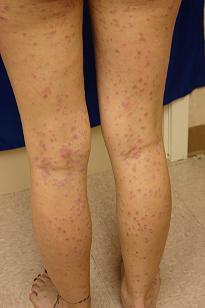
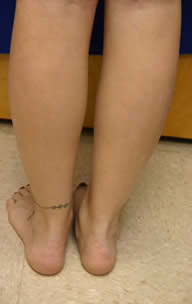
Treatment results vary but may be gratifying |
|
|
Before
Generalized Psoriasis
|
After
10 Weeks of treatment with Humira & Methotrexate
|
Topical Medications
Topical treatments are often the first medications suggested for treating psoriasis. They may be over the counter or prescription. If the psoriasis is confined to relatively small areas topicals can be helpful in reducing redness, scaling and plaques.
Over-the-counter topicals
Salicylic acid
Also known as "sal acid," salicylic acid helps remove scales and is often combined with topical steroids, anthralin or tar to enhance effectiveness. Available in both OTC and prescription forms. Salicylic acid should not be used during pregnancy.
Tar
Coal tar is available in topical, shampoo and bath solution forms. Tar can help slow the rapid proliferation of skin cells and help reduce inflammation, itching and scaling. It can also be used in combination with phototherapy.
Other OTC topicals
Bath oils, moisturizers and lotions can be used to soften, soothe, remove scale or relieve itching.
Prescription topicals
Anthralin
This prescription topical can be very effective in treating plaque psoriasis. It does not work as quickly or as thoroughly as superpotent topical steroids, but unlike steroids, it has no known long-term side effects.
Dovonex (Calcipotriene) and Vectical (Calcitriol)
Synthetic forms of vitamin D3 that slow down the rate of skin cell growth, flatten psoriasis lesions and remove scale. Dovonex is no longer available as a single agent but is available in Taclonex. They can be used on the scalp and for nail psoriasis.
Taclonex
This prescription ointment contains calcipotriene (the active ingredient in Dovonex) and the potent steroid betamethasone dipropionate. The calcipotriene slows down the rate of skin cell growth, flattens psoriasis lesions and removes scale, while the steroid helps reduce inflammation and itch. For treating scalp psoriasis, Taclonex Scalp is available.
Tazorac
Available as a presciption gel or cream (also known by its generic name tazarotene), Tazorac is a vitamin A derivative and is also known as a topical retinoid. It can be used on the face, scalp and nails. As a Pregnancy Category X medication, Tazorac should not be used during pregnancy.
Topical steroids
Corticosteroids, usually called "steroids," are the most frequently used treatment for psoriasis. Topical steroids can be very effective in controlling mild to moderate psoriasis but may not be adequate for moderate to severe psoriasis. However, they may complement other psoriasis treatments that are used to treat severe psoriasis.
The way that steroid medications work is not completely understood. Steroids are referred to as antiinflammatory agents, because they reduce the swelling and redness of psoriasis lesions.
Many brands of steroid medications are on the market. They may look similar, but they differ tremendously in their potency (strength of the medication) and in how they are to be used. Some steroids, for example, should be used only for short periods of time or applied only to certain areas of the skin.
It is essential to use topical steroids properly to avoid unnecessary side effects. This will reduce the risk of side effects, such as thinning of the skin, stretch marks, blood vessels dilating in the skin, discoloration of the skin, acne, folliculitis, excess absorption potentially causing growth retardation or interference with normal hormone production, and rebound of the skin disease when the steroid is stopped. As Pregnancy Category C medications, topical steroids may be used during pregnancy if the benefits outweigh the risks and with the permission of your obstetrician.
Systemic Medications
Systemic medications are prescription medications that affect
the entire body, and are usually reserved for patients with moderate
to severe psoriasis who are not responsive to or eligible for
conventional topical medications or ultraviolet (UV) light treatments.
FDA-Approved "Older" Systemics
Cyclosporine
Cyclosporine is a prescription systemic medication used to treat psoriasis. In 1995, Neoral (one brand name for cyclosporine) was FDA-approved to help prevent organ rejection in transplant patients. In 1997, the FDA approved Neoral as a treatment for psoriasis. Cyclosporine is Pregnancy Catefory C and should only be used by pregnant women with the approval of their obstretrician if the benefits outweigh the risks.
Methotrexate
Methotrexate is a prescription systemic medication usually sold as a generic. Initially used to treat cancer, methotrexate was discovered to be effective in clearing psoriasis in the 1950s and was eventually approved for this use by the FDA in the 1970s. Methotrexate is Pregnancy Category X not to be used during pregnancy. It must be stopped 6 months prior to trying to conceive in both men and women.
Soriatane
Soriatane (acitretin) is a prescription medication called an oral retinoid, which is a synthetic form of vitamin A. Synthetic retinoids were introduced as experimental drugs in the mid-1970s and were approved in the United States in the 1980s. Soriatane is the only oral retinoid approved by the FDA specifically for treating psoriasis. Soriatane is Pregnancy Category X not to be used in women of childbearing potential.
Biologics-FDA-Approved "Newer" Systemics
Biologic medications are developed from living sources, such
as cells, rather than combinations of chemicals like traditional
drugs.
Enbrel: FDA-approved anti-TNF alpha therapy for psoriasis and psoriatic arthritis. Patient-injected, under the skin once or twice a week. All anti-TNF drugs can cause severe immune suppression.
Humira: FDA-approved anti-TNF alpha therapy for psoriasis and psoriatic arthritis. Patient-injected under the skin every other week.
Otezla: FDA-approved inhibitor of the phosphodiesterase 4 enzyme for treatment of plaque psoriasis or active psoriatic arthritis. Patient takes the medication orally 2 x day. Side effects include nausea, weight loss and depression.
Remicade: FDA-approved anti-TNF alpha therapy for psoriasis and psoriatic arthritis. Given by infusion every 6 weeks in a doctor's office.
Stelara: FDA-approved for treatment of moderate to severe psoriasis in adults. Given by subcutaneous injection every 3 months in doctors offices. Weight-based, frst-in-class human monoclonal antibody that targets interleukin-12 and interleukin-23 proteins involved in psoriasis. It can cause immune suppression.
Simponi:
FDA-approved anti-TNF alpha therapy for the treatment of rheumatoid arthritis, psoriatic arthritis (psoriatic arthritis ) and ankylosing spondylitis. It is the first patient-administered anti-tumor necrosis factor (TNF)-alpha therapy that offers once-monthly treatment. ) and ankylosing spondylitis. It is the first patient-administered anti-tumor necrosis factor (TNF)-alpha therapy that offers once-monthly treatment.
Other biologics are being developed for treating psoriasis and
psoriatic arthritis.
Biologics are fairly new treatments for psoriasis and psoriatic
arthritis. Their overall safety is still being evaluated; long-term
side effects are not fully known. Thus far, most biologics for psoriasis have been rated Pregnancy Category B, relatively safe for in pregnant women if the benefits outweigh the risks and with the approval of your obstretician.
Off-Lable "Older" Systemeics
Accutane (isotretinoin), Hydrea (hydroxyurea), mycophenolate mofetil, sulfasalazine, 6-Thioguanine, nonsteroidal anti-inflammatory drugs (NSAIDS), anti-malarials
Adapted from the Psoriasis Foundation website
Modified by Shelley Sekula Gibbs, M.D. November 2014
------------------------------------------------------------------------------------------------
Hidradenitis
Suppurativa
HS causes painful boils and abscesses to form in the groin and underarms theoretically due to blocked apocrine glands. Treatment of HS is difficult - while lancing is not routinely effective and cultures are usually sterile, draining can sometimes provide relief while intralesional steroids often reduce swelling and tenderness. Topical and oral antibiotics, Accutane (isotretinoin), and surgical excision have a role. Excision of the inflamed area may be effective and should be done before sinus tracts spread, if possible. Studies have shown mixed results from anti-androgen therapy and little benefit from finesteride (Propecia) or methotrexate. Immunosuppressants such as systemic steroids, cyclosporine, dapsone, and TNF blockers like etanercept (Enbrel®), adalimumab (Humira®), and infliximab (Remicade®) have been reported to be useful in individual cases. Pain management is important. More information can be found at the Hidradenitis Suppurativa Foundation website.
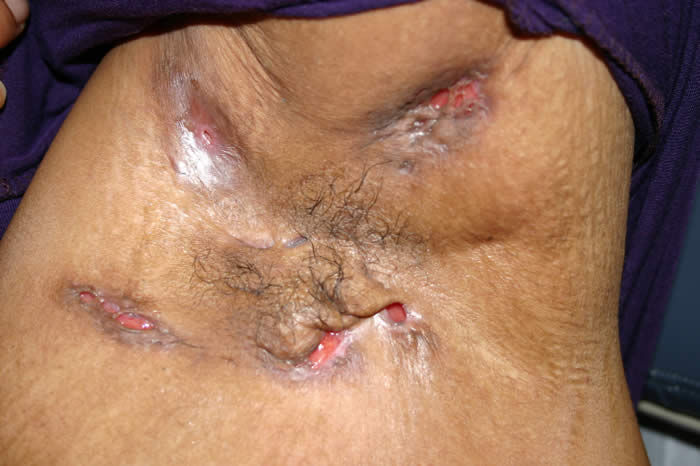
Axilla (underarm) with severe hidradenitis suppurativa
------------------------------------------------------------------------------------------------
LUPUS
Lupus is a Latin word meaning wolf. In medicine, Lupus is an autoimmune disease that can affect various parts of the body, including the skin, joints, heart, lungs, blood, kidneys and brain. The most common organ to be impacted is the skin. Normally the body's immune system makes antibodies to protect the body against viruses, bacteria, and other foreign invaders. These foreign materials are called antigens. In an autoimmune disorder like lupus, the immune system cannot tell the difference between foreign antigens and its own cells and tissues. The immune system then makes antibodies directed against itself. These antibodies -- called "auto-antibodies" (auto means 'self') -- cause inflammation, pain and damage in various parts of the body.
Lupus can be divided into several types:
- Discoid (DLE) - skin rash is the main symptom, although some evidence of lupus can be seen in blood tests
- Sub Acute Cutaneous Lupus Erythematosus (SCLE) - more generalized skin rashes, some systemic symptoms
- Systemic or Acute Cutaneous Lupus Erythematosus (LE) - skin rash may be less significant than internal symptoms
- Neonatal Lupus Erythematosus (Neonatal LE) - skin rash, heart and other problems may be present at birth, the mother usually has lupus but may not be diagnosed.
The cardinal feature of lupus is inflammation which is characterized by pain, heat, redness, swelling and loss of function, either on the inside or on the outside of the body (or both). In the skin inflammation may be seen as a red or purplish rash with a sharp edge, with or without scale, hair loss either diffuse or in patches, swollen tender nail folds, and the well-known butterfly rash on the cheeks (rosacea may mimic this buttrfly pattern). On healing, lupus can leave light or dark marks on the skin.
For most people, lupus is a relatively mild disease affecting only a few organs, usually the skin. For others, it may cause serious and even life-threatening problems. Although epidemiological data on lupus is limited, studies suggest that more than 16,000 Americans develop lupus each year. For some people lupus can be caused by drugs, particularly heart medicines hydralazine, procainamide and occasionally minocycline which is used to treat acne. Discontinuing these medications can sometimes eliminate the lupus symptoms. In some patients there is a family history of lupus or other autoimmune diseases such as rheumatoid arthritis, thyroiditis ulcerative colitis, Crohn's disease, Addison's disease, dermatomyositis, scleroderma, alopecia areata, vitiligo, psoriasis, lichen planus, etc. Some patients will have overlap of lupus with another autoimmune disease. Women are affected more often than men and men tend to have a milder, skin only form called discoid lupus however when men have systemic lupus it can be more aggressive.The Lupus Foundation estimates between 1.5 - 2 million Americans have a form of lupus, but the actual number may be higher.
DIAGNOSING LUPUS
The Eleven Criteria Used for the Diagnosis of Lupus Not All Are Present or Required
Criterion or Symptom |
Definition |
Malar Rash |
Rash over the cheeks |
Discoid Rash |
Red raised patches |
Photosensitivity |
Reaction to sunlight, resulting in the development of or increase in skin rash |
Oral Ulcers |
Ulcers in the nose or mouth, usually painless |
Arthritis |
Nonerosive arthritis involving two or more peripheral joints (arthritis in which the bones around the joints do not become destroyed) |
Serositis |
Pleuritis or pericarditis (inflammation of the lining of the lung or heart) |
Renal Disorder |
Excessive protein in the urine (greater than 0.5 gm/day or 3+ on test sticks) and/or cellular casts (abnormal elements the urine, derived from red and/or white cells and/or kidney tubule cells) |
Neurologic
Disorder |
Seizures (convulsions) and/or psychosis in the absence of drugs or metabolic disturbances which are known to cause such effects |
Hematologic
Disorder |
Hemolytic anemia or leukopenia (white blood count below 4,000 cells per cubic millimeter) or lymphopenia (less than 1,500 lymphocytes per cubic millimeter) or thrombocytopenia (less than 100,000 platelets per cubic millimeter). The leukopenia and lymphopenia must be detected on two or more occasions. The thrombocytopenia must be detected in the absence of drugs known to induce it. |
Antinuclear
Antibody |
Positive test for antinuclear antibodies (ANA) in the absence of drugs known to induce it. |
Immunologic
Disorder |
Positive anti-double stranded anti-DNA test, positive anti-Sm test, positive antiphospholipid antibody such as anticardiolipin, or false positive syphilis test (VDRL). |
Adapted from: Tan, E.M., et. al. The 1982 Revised Criteria for the Classification of SLE. Arth Rheum 25: 1271-1277.
Other Criteria Used for the Diagnosis of Lupus and other Autoimmune Diseases
Skin
Disorder |
Hair loss, with and without rash or scarring; bright red or dark brown patches or bumps on face, scalp, chest, extremities; |
Vascular
Disorder |
Intolerance to cold, fingers turn purple then white, know as Raynaud's phenomenon; erythema and tenderness around fingernails; ulcers and scarring on finger tips |
Other Blood Tests |
A positive antinuclear antibodies, ANA, is often seen in lupus and other autoimmune diseases (+ANA should be in the absence of drugs known to induce it); Sjogren's antibodies (SS-A & SS-B antibodies), Centromere antibodies (often seen in CREST syndrome;, Anti-dsDNA (anti-double stranded DNA); Anti-ssDNA (anti-single stranded DNA), anti-ENA (anti-Smith and RNP antibodies); antiphospholipid antibody (anticardiolipin and lupus anticoagulant); anti-Histone antibodies (may be positive in drug induced lupus; Anti-SCL70 (more often seen in progressive systemic sclerosis also called scleroderma); Anti-JO (more often seen in polymyositis/dermatomyositis), elevated erythrocyte sedimentation rate, ESR; elevated C-reactive protein, CRP; elevated Rheumatoid Factor, RF
----------------------------------------------------------------------------------------------------
HLA-B27 test is associated with the presence of one of a group of diseases called seronegative spondyloarthropathies. This includes diseases such as ankylosing spondylitis (AS), psoriatic arthritis, and Reiter's syndrome. HLA-B27 is present in about 90% of people with AS, but the gene can also be seen in people with no sign of arthritis or inflammation.
----------------------------------------------------------------------------------------------------
ANCA are antibodies found in the blood in most people with Wegener's granulomatosis, a rare disease that affects the upper respiratory tract, lungs, and kidneys. ANCA are uncommon in other diseases, which makes them useful in diagnosing Wegener's.
----------------------------------------------------------------------------------------------------
The complement system is a complicated network of proteins that influence the immune system and inflammation. Decreased levels of various components of complement -- C3, C4, or CH50 -- can be seen in lupus. Other diseases that involve inflammation of the blood vessels -- called vasculitis -- also often have decreased levels of complement in the blood. In systemic lupus, complement levels are used to follow the illness because they go up with worsening and down with improvement of lupus disease activity.
----------------------------------------------------------------------------------------------------
Cryoglobulins are antibodies that may be high in a variety of different diseases, including rheumatoid arthritis, lupus, Sjögren's syndrome, Waldenstrom's macroglobulinemia, multiple myeloma, lymphoproliferative disorders, hepatitis B and C, and other infections. |
TREATING LUPUS
While currently there is no cure for lupus, early diagnosis and proper medical treatment can significantly help control the disease. Dr. Sekula Gibbs will take into account the seriousness and severity of your symptoms and organs involved, your response to treatment as well as your age, health, and lifestyle, and the types and risks of potential side effects from the drugs. Dr. Sekula Gibbs believes in working with your primary care physician and consulting other specialists such as a rheumatologist, cardiologist, nephrologist or neurologist as necessary. Although lupus is a chronic disease, regular follow up, close monitoring and appropriate treatment can reduce inflammation and pain, minimize scarring, help maintain a relatively normal lifestyle and stop the development of serious complications.
Just as the symptoms of lupus vary from one individual to another, your treatment will be tailored to your specific problems. All medicines can have side effects and patients should report problems immediately.
Principal drugs used in the management of lupus
I. Non Major Organ Involvement
(fever, arthritis, pleurisy/pericarditis, rash)
Non-Steroidal Anti-inflammatory
Drugs (NSAIDs)
diclofenac (Cataflam, Voltaren)
etodolac (Lodine)
fenprofen (Nalfon)
flurbiprofen (Ansaid)
ibuprofen (Motrin, Advil, Nuprin)
ketoprofen (Orudis, Actron)
meclofamate (Meclomen)
meloxicam (Mobic)
nabumetone (Relafen)
naproxen (Naprosyn, Napralen, Anaprox, Aleve)
oxaprozin (Daypro)
piroxicam (Feldene)
salicylates (Aspirin, Arthopan)
sulindac (Clinoril)
tolmetin (Tolectin)
Side effects - abdominal pain, heartburn, gastric ulcers and bleeding, fluid retention, rashes, sores in mouth, kidney or liver damage, dizziness or confusion, headache
Anti-Malarials
hydroxychloroquine (Plaquenil)
chloroquine (Aralen)
quinicrine (Atabrine)
Side effects - nausea, abdominal pain/cramps, rash, skin pigmentation, weakness, blurred vision, headache, eye damage, anemia, hepatitis.
Corticosteriods
Topical Creams/Ointments/Intralesional Injections (for skin rashes, nodules hair loss)
clobetasol (Temovate)
halobetasol (Ultravate)
hydrocortisone (Cortef, Cortaid, Westcort, NuCort)
triamcinolone (Aristocort, Kenalog)
betamethasone (Valisone, Diprosone)
flurandrenolide (Cordran)
fluocinolone (Synalar)
fluocinonide (Lidex)
Side effects - skin thinning and pigment changes, superficial blood vessel formation
Tablets
prednisone (Deltasone)
prednisolone (Prelone)
methylprednisolone (Medrol)
Side effects - weight gain, round or moon shaped face, mood changes, thin/fragile skin, acne, diabetes, facial hair, cataracts, osteoporosis, osteonecrosis, muscle weakness, hypertension, gastric ulcers, infections
Intravenous
methylprednisolone (Solu-Medrol)
hydrocortisone (Solu-Cortef)
Side effects - metallic taste, infections, nervousness
Intramuscular
triamcinolone (Kenalog)
Side effects - as with all steroids plus temporary depression or dimpling at the site of injection.
Cytotoxics & Immunosuppressives
methotrexate (Rheumatrex)
Side effects - nausea, abdominal pain, mouth ulcers, rashes, cough, shortness of breath, lung or bone marrow damage, liver damage including hepatitis and cirrhosis, birth defects, miscarriage
azathioprine (Imuran)
Side effects - Nausea or vomiting, pancreatitis, infection, liver disease, cancer
Retinoids and Thalidomide
isotretinoin (Accutane)
acitretin (Soriatane)
Side effects - birth defects, miscarriage, dryness, hair loss, muscle aches, liver and bone marrow damage, mood change
thalidomide
Side effects - birth defects, nerve damage, sedation, mood change
------------------------------------------------------------------------
II. Major Organ Involvement
(nephritis, neurologic disease, etc.)
Corticosteroids See above; typically used in higher doses or as intravenous infusion
Cytotoxics & Immunosuppressives
azathioprine (Imuran)
See above
cyclophosphamide (Cytoxan)
Side effects - nausea or vomiting, rash, infection, hair loss, bladder damage, infertility, cancer
chlorambucil (Leukeran)
Side effects - Nausea or vomiting, rash,infection, hair loss, infertility, cancer
cyclosporine (Sandimmune, Neoral)
Side effects - hypertension, hair growth, tremors, nerve damage, tender or enlarged gums, kidney damage
mycophenolate mofetil (Cellcept)
Side effects - diarrhea, nausea
modified by Shelley Sekula Gibbs, M.D. 2008
-----------------------------------------------------------------------------------------------
Medicare,
Tri-Care, Aetna, BCBS,Cigna and United HealthCare welcome
Care
Credit available
Please
call to see if we accept your insurance
Disclaimer:
Information posted on this web site is for general education
and general information about products and services available
from Dr. Shelley Sekula Gibbs and Bay Oaks Dermatology - Mohs Surgery,
Laser & Vein Center. This information is not medical
advice. It should not be taken as medical advice. Information
should not be used to diagnose or treat a health problem or
disease and is in no way meant to be a substitute for professional
medical care. Visitors to the web site are advised to
schedule an appointment or consult their own physician if
they suspect they have a health condition or serious medical
problem. Every patient has a unique response to
treatment. The results depicted in the photographs on this
site are not necessarily representative of the results you
will receive. No
guarantees or warrantees are implied or given.
The
links to other internet sites are provided solely as a convenience
to the viewer and not an endorsement of any product or service
in such sites. No information in other sites has been
endorsed or approved by Dr. Sekula Gibbs or her staff.
Third party sites may also contain opinions, viewpoints and
content that do not coincide with our opinions. Dr.
Sekula Gibbs and Bay Oaks Dermatology - Mohs Surgery, Laser and Vein
Center do not warrant the validity of any information on
another site nor the content of any "off site" web
pages referenced from a third party. These sites may have
privacy policies different than our privacy policy.
Disclaimer: Information posted on this web site is for general education and general information about products and services available from Dr. Shelley Sekula Gibbs and Bay Oaks Dermatology Skin, Laser and Vein Center. This information is not medical advice. It should not be taken as medical advice. Information should not be used to diagnose or treat a health problem or disease and is in no way meant to be a substitute for professional medical care. Visitors to the web site are advised to schedule an appointment or consult their own physician if they suspect they have a health condition or serious medical problem. Every patient has a unique response to treatment. The results depicted in the photographs on this site are not necessarily representative of the results you will receive. No guarantees or warrantees are implied or given.
The links to other internet sites are provided solely as a convenience to the viewer and not an endorsement of any product or service in such sites. No information in other sites has been endorsed or approved by Dr. Sekula Gibbs or her staff. Third party sites may also contain opinions, viewpoints and content that do not coincide with our opinions. Dr. Sekula Gibbs and Bay Oaks Dermatology Skin, Laser and Vein Center does not warrant the validity of any information on another site nor the content of any "off site" web pages referenced from a third party. These sites may have privacy policies different than our privacy policy.
|