| Melanoma is the most serious form of skin cancer. However, if
it is recognized and treated early, it is nearly 100 percent curable.
But if it is not, the cancer can advance and spread to other parts
of the body, where it becomes hard to treat and can be fatal. While
it is not the most common of the skin cancers, it causes the most
deaths. The American Cancer Society estimates that in 2011 there will be 70,230 new cases of melanoma and 8,790 deaths from melanoma.
Melanoma is a malignant tumor that originates in melanocytes,
the cells which produce the pigment melanin that colors our skin,
hair, and eyes. The majority of melanomas are black or brown.
However, some melanomas are skin-colored, pink, red, purple, blue
or white. The risk of metastasis or spread to distant sites or internal organs is directly correlated to the thickness of the melanoma. A thin melanoma, less than 1 mm in thickness, is the least likely to spread. A thick melanoma over 4 mm in thickness is the most likely to metastasize. The amount of skin removed around the melanoma is determined by the thickness. "In Situ" melanoma, confined to the epidermis, and other thin melanomas less than 1 mm in thickness are typically removed with a 10 mm radius of normal skin. Thicker melanomas are usually removed with a 20 mm radius of normal skin.
In addition to thickness, other parameters, such as mitotic rate and the presence of ulceration, may also impact the likelihood of melanoma spreading to lymph nodes and internal organs. The Skin Cancer Foundation has more information on staging and treatment options for melanoma. The American Academy of Dermatology has more information on how to diagnose melanoma.
ABCDEs of Melanoma Detection
Look for Danger Signs in Pigmented Lesions of the Skin
Consult your dermatologist immediately if any of your moles or pigmented spots exhibit:

One half is unlike the other half.

An irregular, scalloped, or poorly defined border.

Is varied from one area to another; has shades of tan, brown, or black; is sometimes white, red, or blue.

Melanomas usually are greater than 6mm (the size of a pencil eraser) when diagnosed, but they can be smaller.
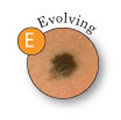 
A mole or skin lesion that looks different from the rest or is changing in size, shape, or color.
Am I at Risk?
Everyone is at some risk for melanoma, but increased risk depends
on several factors: sun exposure, number of moles on the skin,
skin type and family history (genetics).
Sun Exposure and Tanning Beds
Both UVA and UVB rays are dangerous to the skin, and can induce
skin cancer, including melanoma. Blistering sunburns in early
childhood increase risk, but cumulative exposure also is a factor.
People who live in locations that get more sunlight —
like Texas, Florida, Hawaii, and Australia — get more
skin cancer. People who have used tanning beds, even occasionally, are at increased risk of melanoma. Avoid using a tanning booth or tanning bed, since
it increases your exposure to UV rays, increasing your risk
of developing melanoma and other skin cancers. Sunless tanners are OK. Get extra Vitamin D in supplements and in dairy products.
Moles
There are two kinds of moles: normal moles — the small
brown, tan or pink growths or "beauty marks" that appear
in the first few decades of life in almost everyone —
and atypical moles that are flat, irregular brown, pink or tan growths also known as dysplastic nevi. Regardless
of type, the more moles you have, especially over 40 moles, the greater your risk for
melanoma.
Skin Type
As with all skin cancers, people with fairer skin, light hair and light colored eyes are at increased
risk of melanoma.
Family History
About one in every ten patients diagnosed with melanoma
has a family member with a history of melanoma. If your mother,
father, siblings or children have had a melanoma, you are in
a melanoma-prone family. Each person with a first-degree relative
diagnosed with melanoma has a 50 percent greater chance of developing
the disease than people who do not have a family history. If
the cancer occurred in a grandmother, grandfather, aunt, uncle,
niece or nephew, there is still an increase in risk, although
it is not as great.
Personal History
Once you have had melanoma, you run an increased chance of
recurrence. Also, people who have or had basal cell carcinoma
and squamous cell carcinoma are at increased risk for developing
melanoma. If you have had intense sunburns as a child or used indoor tanning beds you will have an increased risk of melanoma.
Weakened Immune System
Compromised immune systems as the result of chemotherapy, an
organ transplant, certain other medications, excessive sun exposure, and diseases such
as HIV/AIDS or lymphoma can increase your risk of melanoma.
If you are in any of these risk groups, you can protect yourself
and your children by practicing safe sun habits, that is using a sunscreen every day and donning protective clothing and a hat when in the sun, remembering
to self-examine your skin monthly, watching for the warning signs of melanoma
and getting yearly exams by a dermatologist.
Moles in an Active Stage
Moles in people belonging to melanoma-prone families are subject
to change at certain times of life. They may get larger or show
alterations in color or elevation, so for those periods, they
are described as being active. While the reasons for these changes
are not fully known, there could be a hormonal component: Moles
are more active at puberty and during pregnancy. It is unknown whether taking oral contraceptives
or hormone replacement therapy has any bearing on developing melanoma or causing it to spread. Discuss this with your dermatologist.
Examination Scheduling
Individuals with the many moles or lots of atypical moles can improve their
chances of early detection by increasing the frequency of skin
self-examination and by visiting a dermatologist more often. The
dermatologist may take photographs or measure the moles to document whether there are
new moles or changes in older ones. The patient and family members even the hair dresser or barber can assist by looking out for changes.
|